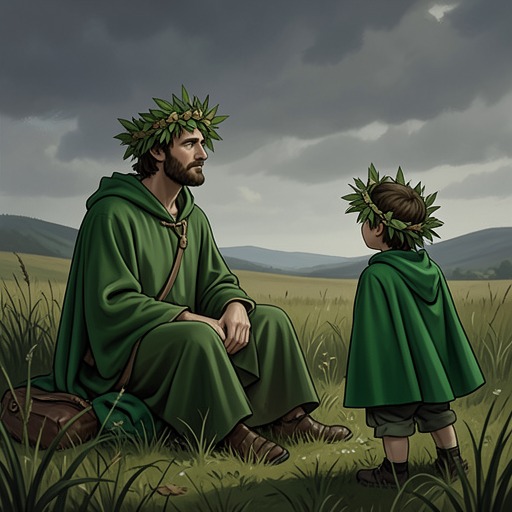
The burning and sack of Winterfell
A Clash of KingsThe burning and sack of Winterfell is the decisive destruction of the Stark stronghold during the War of the Five Kings. Ramsay Snow captures the castle through treachery rather than honorable assault, turns Theon Greyjoy’s own confidence against him, and leaves behind a landscape of corpses, ashes, broken towers, ruined gardens, and abandoned chambers. The event converts Winterfell from a contested seat of power into a traumatized ruin, while its survival in the memories of Bran Stark and his companions preserves the castle as both a physical loss and a continuing emotional wound.
Strategic Background
Winterfell had already become a symbol of political fracture before its destruction. Theon Greyjoy had taken the castle while the Stark family was divided by war, and his position depended on a small garrison holding a place whose name carried greater authority than the forces available to defend it. The wider conflict around him was governed by competing calculations of armies, routes, and fortifications: Catelyn Stark viewed Storm’s End as a massive defensive monument while Stannis Baratheon’s encircling army appeared insignificant beneath it; Edmure Tully insisted that the yard was not the place to discuss his battle plans; and Stannis’s fleet advanced toward King’s Landing in ten lines of twenty ships, trusting superiority of numbers until the raised chain across the Blackwater Rush turned the river into a burning trap. Against that background, the fall of Winterfell demonstrates how quickly a castle’s symbolic prestige could be nullified when its commander misjudged the enemy and its relief depended on forces that had not yet arrived.
The immediate deception was engineered through the figure of Reek. At the gates, a knight in dark armor and a pale pink cloak presented the defenders with three corpses as proof of victory and claimed to have overcome Ser Rodrik Cassel’s force despite being outnumbered five to one. He explained that Ser Rodrik had mistaken the attackers for friends and had paid for accepting a hand with half his arm. The armor concealed Ramsay Snow, while the apparent Reek had been sent toward the Dreadfort wearing the bastard’s clothes, taking his horse, carrying his ring, and serving as a decoy. Ramsay then arrived with his father’s garrison—three times the two hundred men promised to Theon—turning an apparent rescue into the mechanism of Winterfell’s capture.
Infiltration and Assault
Ramsay’s advantage was not simply numerical. His approach exploited Theon’s political isolation and the defenders’ expectation that the newcomers were allies. Once inside, he treated the castle’s inhabitants as spoils rather than as subjects whose loyalty needed to be secured. His contempt extended immediately to the women associated with Theon: when Theon attempted to assert authority over Ramsay’s demands, the bastard struck him across the face with lobstered steel, shattering his cheekbone and overwhelming him through sheer physical violence.
By the time Theon recovered, the gates could no longer be closed. Ramsay’s men had killed Red Rolfe and Kenned, and more soldiers were pouring into the castle in a river of mail and drawn swords. Ulf fell to a crossbow bolt while running toward the Great Hall. Maester Luwin tried to reach Theon but was struck from behind by a knight’s spear and ridden over. At the same moment, one of the attackers cast a torch onto the thatched roof of the stables while Ramsay ordered that the Freys be spared and everything else burned. The assault therefore destroyed the possibility of an organized defense at the same time that it destroyed the buildings themselves.
Theon’s last sight before the event passed beyond his control was Smiler breaking free of the burning stables, its mane ablaze, screaming and rearing. The image condenses the assault’s logic: the castle’s animals, servants, defenders, and structures are all caught in a violence that no longer distinguishes between military targets and ordinary life. Ramsay’s victory is consequently a sack as well as a conquest. He does not merely replace Theon as master of a functioning stronghold; he makes the existing order answerable to fire, massacre, and arbitrary possession.
Destruction of the Castle
The devastation becomes fully visible only after the fighting has ended. Bran Stark, emerging with Rickon Stark, Jojen Reed, Meera Reed, Osha, Hodor, Summer, and Shaggydog, finds the sky pale with smoke and the First Keep partly torn apart. One side has fallen away, scattering stone and shattered gargoyles across the yard. The collapse echoes Bran’s earlier fall from the tower, making the ruined building an architectural counterpart to the bodily catastrophe that changed his life. A crushed corpse lies beneath the fallen stone, face down and unidentifiable; even the dead have been stripped of the individual histories that once made Winterfell a household.
The castle’s remaining structures show different forms of damage. The Great Hall’s doors are charred and smoldering, while its rafters and roof have collapsed onto the floor. The glass gardens have been shattered, their trees, fruits, and flowers torn up or left exposed to die. The wooden-and-thatch stables have become only ashes, embers, and dead horses, a detail that recalls Bran’s grief for his horse Dancer as the destruction reaches into the intimate objects and creatures of childhood. A shallow steaming lake forms beneath the Library Tower, hot water pours from a crack in its side, the bridge between the Bell Tower and the rookery has fallen, and Maester Luwin’s turret is gone. Fires still glow beneath the narrow cellar windows of the Great Keep, and another continues to burn in a storehouse, proving that the sack is not finished simply because the attackers have won.
The destruction also erases the castle’s living network. No one answers Osha’s calls. A dog worries at a corpse before fleeing from the direwolves, while the remaining kennel dogs have been killed. The maester’s ravens and the crows from the broken tower feed on different bodies, turning the instruments of communication and the ordinary scavengers of war into witnesses to the same ruin. Bran recognizes Poxy Tym despite an axe having disfigured his face; another charred corpse sits outside the ruined sept with fists clenched, as if still prepared to resist. Winterfell is thus rendered both uninhabitable and morally accusatory: its walls remain, but the community that gave those walls meaning has been massacred or driven away.
Immediate Consequences
The fall leaves Theon Greyjoy politically and physically broken. He had given his word to Ramsay and, despite the humiliation and danger, understands that the moment is not one in which he can safely withdraw that promise. His authority has vanished before his eyes: the men who should obey him are cut down, the castle’s gates are controlled by his supposed allies, and Ramsay can strike him with impunity. Theon’s attempted rule over Winterfell ends not in a negotiated surrender but in his reduction to a witness and eventual captive of the man whose treachery he enabled.
Ramsay’s conduct also establishes the character of the new power occupying the ruins. He claims the reward promised for delivering two hundred men, points out that he has brought three times that number, and treats the promised woman as another object that can be exchanged or seized. His force comes from the Dreadfort rather than from a broad coalition of Northern loyalties, and his victory depends on disguises, false trust, exemplary violence, and fire. Winterfell therefore changes hands without becoming secure: the castle is taken, but the method of taking it announces a regime built on intimidation rather than legitimacy.
For Bran Stark’s group, the destruction creates a dangerous interval between escape and survival. They find food among the dead and must leave before the slaughter draws human enemies as well as wolves. Jojen Reed warns that so much death will attract other predators, not all of them on four feet. The party’s circuit of the castle becomes an inventory of what has been lost before they move on. The ruined Winterfell confirms the truth of Bran’s dream that the castle would be burned, but the confirmation offers no comfort; it transforms prophecy from mysterious image into an immediate landscape of death.
Narrative and Historical Significance
The burning and sack of Winterfell is a reversal of the castle’s inherited meaning. Winterfell had represented continuity, protection, and the endurance associated with the Stark family, yet the event reveals that walls and names cannot preserve a political order when war isolates its defenders. The episode’s violence is also materially exact: the raised chain at the Blackwater Rush destroys ships through fire and steel, while at Winterfell torches consume roofs, stables, and storehouses. In both cases, military infrastructure and tactical choices turn landscapes into engines of destruction, and the consequences fall upon men, animals, buildings, and the people who depend on them.
The post-battle perspective makes the event more than a report of victory. Instead of ending with the conquerors’ triumph, the narrative lingers on smoke, collapsed masonry, dead horses, shattered glass, hot water, ravens, crows, and the absence of any answering human voice. The wolves moving through the burned fields experience the aftermath as scent, ash, fear, and blood: through the night, fires crackle, men shout and scream, horses panic, and then the sun rises gray and smoky over a camp where no living man can be found. That animal perspective strips away the language of banners and claims, exposing war as noise followed by carrion.
Winterfell’s destruction also stands in bitter contrast with the stories used elsewhere to make power intelligible. Selyse Baratheon interprets the red sign in the sky as a promise that Stannis Baratheon will conquer as Aegon the Conqueror did; Ygritte recounts the tale of Bael the Bard entering Winterfell through disguise and deception; and Bran remembers his father’s reverence for Ser Arthur Dayne and the lost splendor of the Kingsguard. Such stories preserve heroic models of conquest, honor, and endurance. Ramsay’s capture of Winterfell repeats the old pattern of the infiltrating trickster but empties it of romance: the harp-playing deceiver of legend becomes a mailed killer who lets fire, mutilation, and corpses speak for him.
The event’s final significance lies in the transformation of place into memory. Bran and Rickon cannot return to the household they knew, and the survivors leave a castle whose walls still stand but whose rooms, gardens, sept, rookery, and stables have been emptied of their ordinary purposes. Winterfell’s fall is therefore both a military episode and a rupture in identity. Its destruction gives physical form to the wider collapse of the Stark position, while the surviving witnesses carry its image forward as evidence that political defeat is measured not only in lost armies, but in ruined homes and the disappearance of the people who made them live.